
Renovate2Recover One Year On: what progress on buildings renovation?
The National Recovery and Resilience Plans (NRRPs) were approved in the aftermath of COVID in 2021, well before the war in Ukraine and the subsequent energy price and cost-of-living crisis. The aim of the Recovery Facility is to provide a stimulus that would lift Member States’ economies out of the post-COVID slowdown, while boosting digitalisation and helping Member States to achieve the EU’s 2030 and 2050 climate goals.
The energy crisis acts as an additional driving force for pursuing the buildings-related reforms and investments planned in the NRRPs. As Commission President von der Leyen stated in October 2022, “faced with war, with a fossil fuel crisis, the arguments in favour of the Renovation Wave have only become more pressing. Investing in renovation is a no regret option.”
In 2021, the Renovate2Recover study found that, amongst the 18 Member States’ NRRPs analysed, €39.9bn* was allocated to buildings renovation (about 8% of the total). This brief provides an update on progress after one year of implementation, and looks at the work that has begun to unlock buildings-related investment worth at least €28bn.
This briefing looks at which buildings-related measures were implemented, which targets and milestones were met, and what financial support was provided to Member States until the end of September 2022. There has been slow but steady progress on buildings-related measures, led by reforms and the entry into force of new financing programmes.
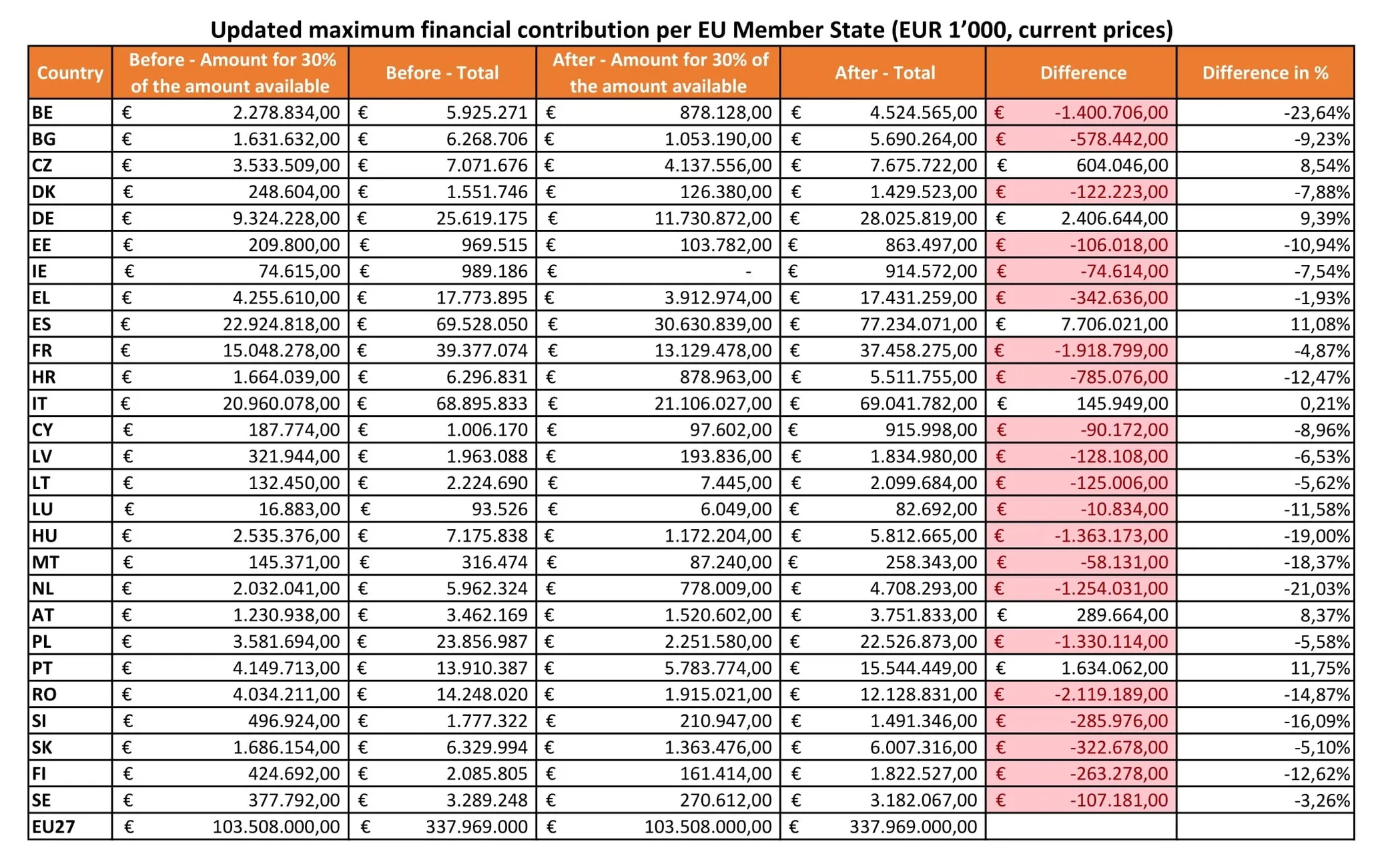
Updated maximum grant allocations in the National Recovery and Resilience Plans
The European Commission has published the updated grant amounts for Member States under the Recovery and Resilience Facility (RRF). This update is taking place because 30% of the initial maximum grant amount was based, in part, on real GDP growth estimated in the 2020 Autumn Economic Forecast and, according to the RRF Regulation, this had to be updated based on actual Eurostat data by 30 June 2022. To take effect, these changes will have to be adopted in an updated Council Implementing Decision.
Renovate2Recover: how transformational are the National Recovery Plans for buildings renovation?
The Renovate2Recover study, undertaken by E3G for the Renovate Europe Campaign and launched on 13 October 2021 at the REDay2021 conference, assesses the buildings-related elements of the National Recovery and Resilience Plans (NRRPs) in 18 Member States: Austria, Belgium, Bulgaria, Croatia, Czechia, Denmark, France, Germany, Greece, Hungary, Ireland, Italy, Latvia, Poland, Romania, Slovakia, Slovenia and Spain. The aim is to understand whether the NRRPs position countries to achieve longer-term targets for more and deeper renovation, and whether they have the potential to be “transformational” on the path to achieving the national goals set out in the Long-Term Renovation Strategies and the EU goals set out in the Renovation Wave strategy. The study was developed by E3G, bringing its experience of working on the Green Recovery Tracker, and was delivered in close cooperation with Renovate Europe’s National Partners and Campaign Office.
Renovate Europe’s National Partners have made substantial and crucial contributions to the content and value of this study. With their understanding of the national context and their contacts with national governments, they are perfectly positioned to contribute to the assessment of the NRRPs and, crucially, to act on the opportunities identified in each country profile to improve and support the implementation of NRRPs across the EU.
Each country profile is accompanied by an annex that sets out, in more detail, the various programmes and reforms that each Member State includes in its NRRP. Where possible, the funding allocation for each programme is also included. The content of these annexes is drawn from an analysis of the European Commission’s assessment of the NRRPs and the Council Implementing Decision for each NRRP.
What buildings elements in the National Recovery Plans?
This short document seeks to provide a checklist of key elements to be included for buildings in the National Recovery and Resilience Plans (NRRPs), taking into account upcoming legislative developments (the revision of the Energy Efficiency Directive and the Energy Performance of Buildings Directive). Tying the national plans to a long-term regulatory perspective will increase the absorption rate of EU funding and improve the implementation of EU buildings policies on the ground, thereby contributing to multiple benefits for Member States, their businesses and their citizens.
- Allocation for capacity building or technical assistance
- Segment-based approaches with measurable outcomes
- Deep renovations achieving low energy consumption levels
- Support for upskilling the workforce
- Focus on scaling up existing renovation schemes
- Uptake of loans and other financial instruments
- Better aggregation of data to measure impact
Prioritise energy renovation in the National Recovery and Resilience Plans!
At the July European Summit, EU leaders agreed a recovery package and the 2021–2027 budget to help rebuild the EU after the pandemic and boost investment in the green and digital transitions. This is a unique opportunity to allocate this money towards energy renovation.
Member States are currently drafting National Recovery and Resilience Plans, to be submitted to the European Commission from 15 October, outlining where they will allocate the funding to be awarded from the EU Recovery Package.
Prioritise energy renovation in the National Recovery and Resilience Plans!
- Read our FAQ document: “Why should I prioritise energy renovation in the National Recovery and Resilience Plan for my Member State?”
This provides short answers on why buildings are so important for our health, why energy renovation is in line with the EU’s growth objectives and green priorities, what the link is between the Renovation Wave and the National Recovery Plans, whether the renovation sector is ready to deliver, and what kind of funding needs to be included for energy renovation in the national plan.
- Read our practical guide explaining how to include energy renovation: “National Recovery Plans, European Semester & DG REFORM: How Energy Renovation fulfils all criteria to disburse EU Recovery Funding fast in your MS”
This guide looks at some of the practical aspects: how energy renovation complies with the assessment criteria, how it ties in with the European Semester, how DG REFORM’s support can help finance energy renovation, how to access this technical support, and what other funds are available for energy renovation.