
The EU package on financing energy efficiency
On 10 March 2026 the European Commission adopted a package on financing energy efficiency. It looks at how much money building renovation needs, how much is invested today and how Member States can bring in more private finance. Together with the Energy Performance of Buildings Directive, it guides Member States, banks and investors on how to scale up investment in building renovation.
Recommendation
Unlocking private investment in energy efficiency
The Commission makes twelve recommendations to Member States. They include national energy efficiency funds, loans and grants combined in one offer, project development assistance, energy efficiency mortgages and renovation loans, repayment through energy bills or property tax, energy performance contracting, public guarantees and refinancing.
Recommendation (EU) 2026/536
Practical guidance on one-stop shops
It explains how national, regional and local authorities can set up one-stop shops that give homeowners technical, financial and administrative help from the start of a renovation to the end.
Report
Energy efficiency financing in Europe
The report looks at EU and national spending on energy efficiency since 2014. EU funding for energy efficiency rose from €21 billion in 2014–2020 to €144.7 billion in 2021–2027, three quarters of it from the Recovery and Resilience Facility.
Strategy
Clean Energy Investment Strategy
The EU needs €660 billion a year of clean energy investment until 2030, mostly from private capital. For energy efficiency, the strategy plans a €500 million pilot and stronger support through InvestEU.
EPBD, Article 17
Financial incentives and a lending framework
Member States must keep applications for public funding simple and make information on funding easy to find. The Commission is preparing a voluntary portfolio framework to help banks lend more for energy renovation.
The investment gap in figures
The Commission’s March 2026 report shows how far investment in building renovation falls short of what the 2030 targets need.
- €242bn
- is needed every year from 2021 to 2030 for energy efficiency in buildings: €180 billion for homes and €62 billion for non-residential buildings
- Source: European Commission, Report on Energy Efficiency Financing in Europe, March 2026 (opens in a new tab)
- €170bn
- a year is missing between the investment the 2030 targets need and the roughly €200 billion a year invested from 2021 to 2023
- Source: European Commission, March 2026, based on IEA estimates (opens in a new tab)
- 15%
- of the investment needed is covered by public money, EU and national together: about €53 billion a year
- Source: European Commission, March 2026 (opens in a new tab)
- €79.4bn
- from the Recovery and Resilience Facility went to energy efficiency in buildings, and the facility closes at the end of 2026
- Source: European Commission, March 2026 (opens in a new tab)
More figures on energy use, the building stock and energy poverty are on our Facts and figures page.
What we ask for the next EU budget and from lenders
These asks come from our April 2026 position on the 2028–2034 EU budget and from our work with Climate Strategy & Partners on retail lending.
An EU Renovation Loan facility
The facility would sit in the InvestEU instrument of the European Competitiveness Fund and give guarantees to retail banks and other lenders for low-interest renovation loans. It would reach owner-occupied homes, around 70% of all homes in the EU.
Renovation in every Partnership Plan
Each National and Regional Partnership Plan should have a building renovation priority, in line with the National Energy and Climate Plans and the National Building Renovation Plans.
Spending that counts real savings
The budget should have a 50% climate and environment spending target. Its tracking method should capture real energy savings, social impact and the quality of the works.
Support to deliver
EU funding should pay for technical assistance, trusted one-stop shops, skilled intermediaries and quality control, and the procedures should be simpler.
Mortgage portfolio standards
We want mortgage lenders to adopt them voluntarily, as the EPBD encourages, so that banks help their clients improve the homes they lend against.
EU funding for building renovation
The EU budget supports building renovation through several funds, most of them run by national and regional authorities. The Recovery and Resilience Facility is closing this year, and the next EU budget will start in 2028.
EU fund, 2026–2032
Pays for: insulation, new heating and cooling systems and solar panels for vulnerable households and micro-enterprises. €86.7 billion over seven years.
How to apply: through national schemes. Each Member State’s Social Climate Plan sets out how its share will be spent.
EU funds, 2021–2027
Pays for: renovation of homes and public buildings through regional programmes (ERDF and Cohesion Fund), and skills through ESF+. Since 2025, regions can move money into affordable, energy-efficient housing, with the EU paying up to 100%.
How to apply: through your national or regional managing authority. Projects must be paid for by the end of 2029.
Our study: how Member States planned to use 2021–2027 cohesion funding for renovation (April 2023).
EU recovery fund, 2021–2026, closing
Recovery and Resilience Facility
What it paid for: €79.4 billion went to energy efficiency in buildings through the National Recovery and Resilience Plans, the largest EU source of renovation money since 2021.
Where it stands: Member States had to complete their plans’ milestones and targets by 31 August 2026 and send their last payment requests by 30 September. The Commission makes the final payments by 31 December 2026, and there will be no extension.
Our analysis: our Renovate2Recover studies looked at how the national plans treated building renovation.
Calls for proposals, once a year
LIFE Clean Energy Transition (CINEA)
Pays for: coordination and support projects that put EU energy policy into practice. They cover national, regional and local energy policy; new services, business models and skills, including one-stop shops and BUILD UP Skills; private finance for sustainable energy; help to prepare local and regional investment projects; and involving citizens, from energy communities to tackling energy poverty. It does not pay for the works.
How to apply: answer CINEA’s yearly call. The 2026 calls (€85.5 million) closed in September. The last round under this budget is due in 2027.
Work with us: Renovate Europe can join your consortium for stakeholder engagement, communication and policy work. See EU projects.
EU budget 2028–2034, in negotiation
Where it stands: the Commission proposed the budget in July 2025. Council and Parliament aim to agree it by the end of 2026.
What we ask: a building renovation priority in every National and Regional Partnership Plan, an EU Renovation Loan Facility, and a way to track energy savings. See What we ask above.
Bringing private finance into renovation
Public money covers about 15% of what building renovation needs. The rest has to come from building owners, banks and investors, and governments and lenders are starting to work on it together.
The European Energy Efficiency Financing Coalition
The European Energy Efficiency Financing Coalition brings together Member States, the Commission, financial institutions and industry. Most Member States now have a national hub, where ministries, banks and the building sector meet.
What banks and lenders are doing
Mortgage lenders reach more homeowners than anyone else in the renovation market. Some already price energy performance into their loans.
- Mortgage rates by energy label. Since 30 April 2025, ING in the Netherlands sets its mortgage rate by the home’s energy label, from G to A++++, and lowers the rate when the label improves. Its Upgrader service gives free advice, help with subsidies and access to installers.
- Mortgage portfolio standards. Over a third of the 30 largest European banks have a voluntary target to improve the energy performance of the homes they lend against. The EPBD encourages lenders to adopt them.
- Filling data gaps. BNP Paribas and Deutsche Bank use models to estimate missing energy performance certificates, so they can measure the energy performance of their mortgage books.
National schemes that bring in private lenders
In these schemes, building owners get public money and a bank loan in a single offer.
Ireland, since 2024
Home Energy Upgrade Loan Scheme
€500 million of low-cost loans, from 2.99%, backed by an EIB Group guarantee and offered through banks, An Post and credit unions. Homeowners borrow €5,000 to €75,000 without security over up to 10 years. Applications are open until 31 December 2026.
Czechia, since 2024
Repair your grandma’s house (Oprav dům po babičce)
A grant paid up front covers up to half the cost of renovating an older family house. Banks and building societies lend the rest at a capped rate over up to 20 years, with no mortgage on the house. The Modernisation Fund provides half of each loan.
France, third-party financing
Regional companies combine technical help with long-term loans whose repayment counts the expected energy savings. From mid-2020 to mid-2024 they financed 2,280 house renovations (€109 million) and 11,435 flats in 203 buildings (€228 million). FIDEO, a bank for renovation, is being set up to refinance them.
Greece, 2025–2026
Upgrade my home (Anavathmizo to spiti mou)
Interest-free loans of €5,000 to €25,000 for the energy upgrade of a home, with no collateral, repaid over 3 to 7 years. The Recovery and Resilience Facility funds 75% of the €82.67 million budget and nine Greek banks lend the rest, with the state paying the interest on the bank share. The Hellenic Development Bank runs the scheme.
One-stop shops: where finance meets building owners
A one-stop shop guides building owners through a renovation, from advice and an energy audit to contractors, grants, loans and checking the works. The EPBD requires every Member State to set them up.
What we heard at our April 2026 webinar with FEDARENE:
- Horizon 2020 and LIFE have set up 51 one-stop-shop services in 16 Member States.
- There is no single model. Some give advice, others manage the whole project, and some also carry out the works and arrange the loan.
- They cost money to run, so they need regular funding in national programmes.
Find out more from EU-PEERS, the community of one-stop-shop practitioners, and from our partners’ projects, our 2022 webinar and our 2022 briefing with E3G.
De-risking and blended finance from the EIB and the Commission
The EIB Group and the Commission share risk with lenders, combine loans with grants and help public authorities prepare projects that banks will finance.
Technical assistance, EIB
ELENA (European Local Energy Assistance)
Pays for: up to 90% of the cost of preparing a renovation programme worth over €30 million: energy audits, business plans, tenders, grouping small projects together.
How to apply: public authorities, social housing and homeowner associations contact the EIB directly. There is no deadline.
Advisory, Commission and EIB
fi-compass helps managing authorities that use cohesion funds for loans and guarantees. It offers model financial instruments and runs the Scale-Up initiative on combining loans with grants and on state aid rules.
Housing, Commission and EIB
Pan-European Investment Platform for Affordable and Sustainable Housing
The platform launches in 2026. It will pool public and private money for affordable housing, renovation included, and will have a portal, an expert group and voluntary national financing hubs. The EIB Group plans €6 billion for housing in 2026.
Database
De-risking Energy Efficiency Platform (DEEP)
It holds performance data on more than 89,000 energy efficiency projects in buildings and industry, so lenders and investors can judge their risks and returns.
For businesses, EIB Group
The EIB Group is making €17.5 billion available from 2025 to 2027 through partner banks. It is for small and medium-sized companies that invest in energy efficiency, including in their own buildings.
Our events on financing renovation
Since 2021 we have brought banks, investors, EU institutions and one-stop shops together to debate renovation finance. The recordings, presentations and highlights are linked from each event.

4 May 2026, Brussels
Mobilising Private Financing for Affordable Building Renovation
Organised with Climate Strategy and IIGCC. Speakers from ING, Deutsche Bank, Slättö and European DataWarehouse discussed securitisation and data.

22 April 2026, online
Empowering Citizens to Renovate: Examples of One-Stop Shops
Organised with FEDARENE. CINEA, FIDEO and one-stop shops from Slovenia, Italy and Bulgaria spoke, and the recording and presentations are online.
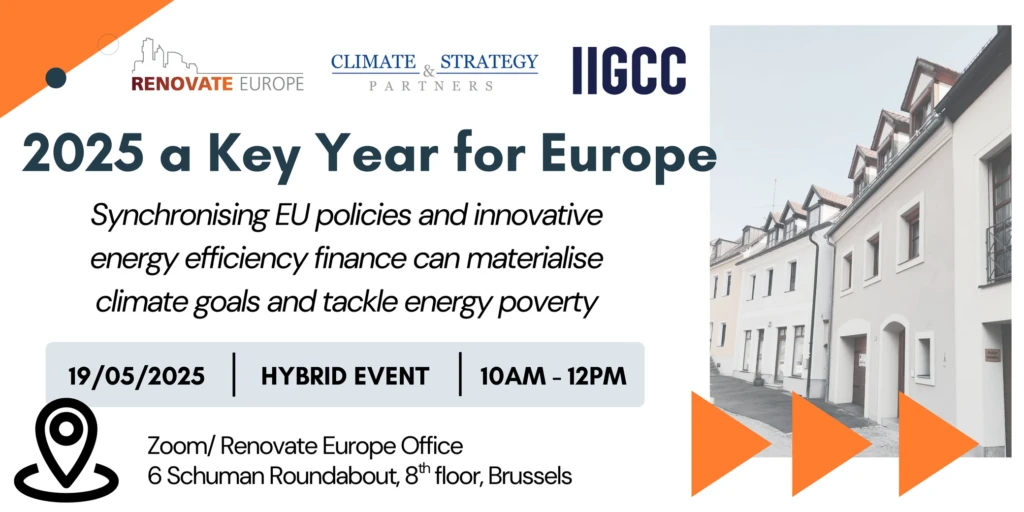
19 May 2025, Brussels
Private Financing for Energy Renovation
Organised with Climate Strategy and IIGCC, with speakers from ING, DWS, AXA, the EIB and ESBG and a keynote on the EU Renovation Loan.

23 April 2024, Brussels
Engaging Retail Lenders in Home Renovations
Organised with Climate Strategy, with speakers from ING, BNP Paribas, Deutsche Bank, the European Banking Authority and DG ENER.

21 March 2022, online
One-Stop-Shops: Maximising their potential to accelerate energy renovation
Our national partners from Hungary, Ireland, Latvia and Poland spoke, along with the City of Warsaw and CINEA.
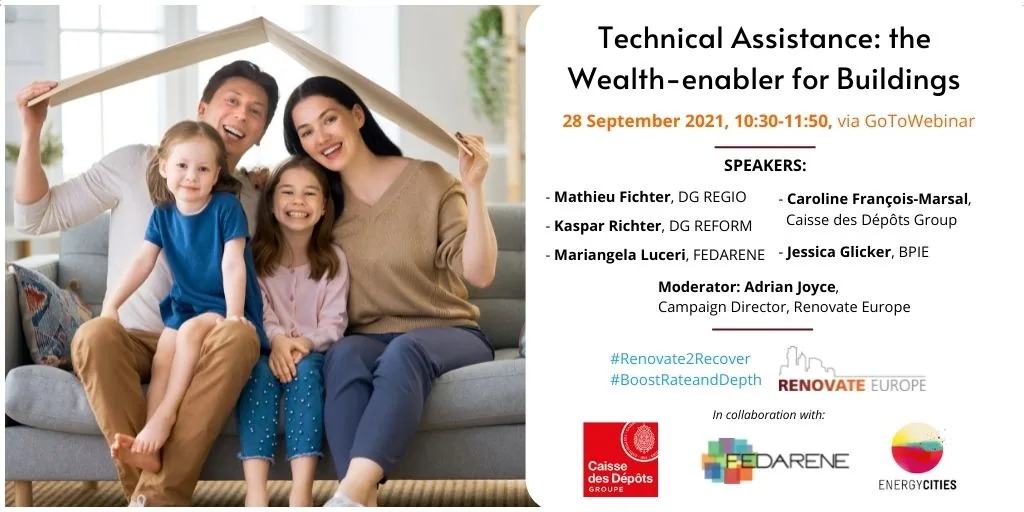
28 September 2021, online
Why and how is technical assistance the wealth-enabler for buildings?
Organised with FEDARENE and Energy Cities, with speakers from DG REGIO, DG REFORM, Caisse des Dépôts and the EIB.
Banks and investors: join the campaign
Financial institutions, promotional banks and investors can join Renovate Europe as partners and shape our work on renovation finance.
Our earlier work on EU funding for renovation
Our studies and positions on EU funding for renovation from 2020 to 2023.
Study, April 2023
2021–2027 cohesion policy support for energy efficiency and building renovation
An estimated €20 billion of cohesion funding is programmed for energy renovation and energy efficiency, or €29 billion with national co-financing.
Study, December 2022
Renovate2Recover One Year On: What progress on building renovation?
How far the National Recovery and Resilience Plans had got with building renovation a year after they were approved.
Study, October 2021
Renovate2Recover: How transformational are the National Recovery Plans for Buildings Renovation?
Our assessment of how well the national recovery plans support building renovation.
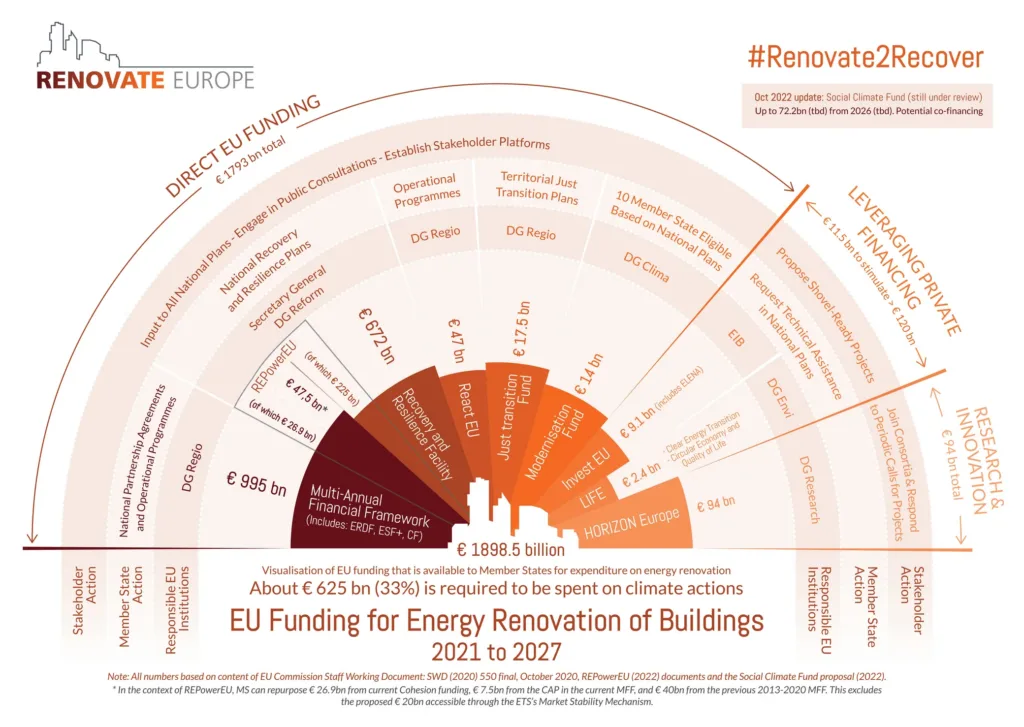
Infographic, October 2022
EU funding for energy renovation of buildings, 2021–2027
The EU funds that could pay for renovation in 2021–2027, with their budgets as they stood in 2022.
Op-ed, Energy Monitor, October 2022
Eyes to the horizon during a crisis
Member States spent more than €570 billion from September 2021 to cushion the energy crisis, while long-term investment in renovation stalled.
Joint call, April 2020
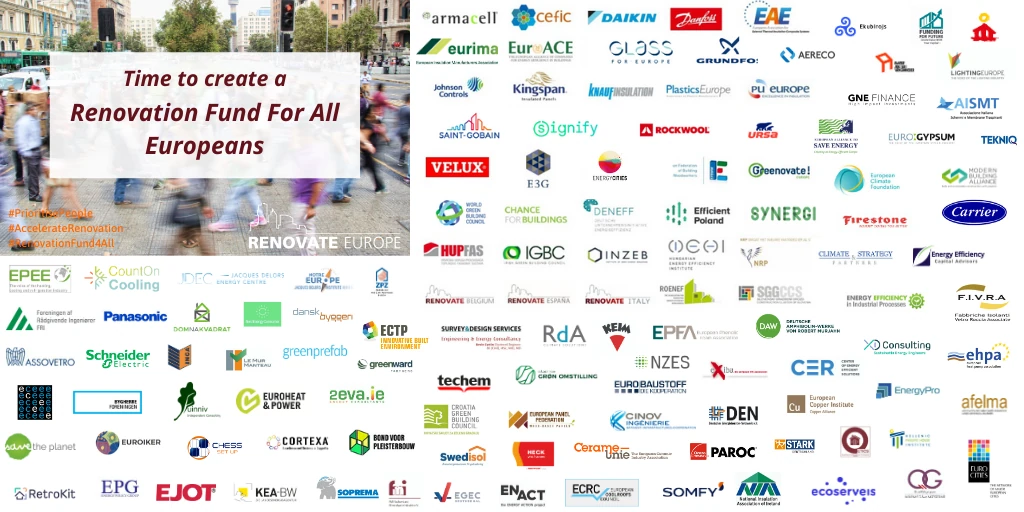
Renovation Fund for All Europeans
With 39 of our partners, we proposed an EU fund for building renovation.