With energy prices putting renewed pressure on European households and businesses, accelerating building renovation is more important than ever. It is essential not only to reduce energy bills and to strengthen energy security, but also to make homes healthier and more comfortable.
National Building Renovation Plans (NBRPs) offer a key opportunity to align stakeholders, scale up proven solutions and turn Europe’s building energy goals into measurable results.
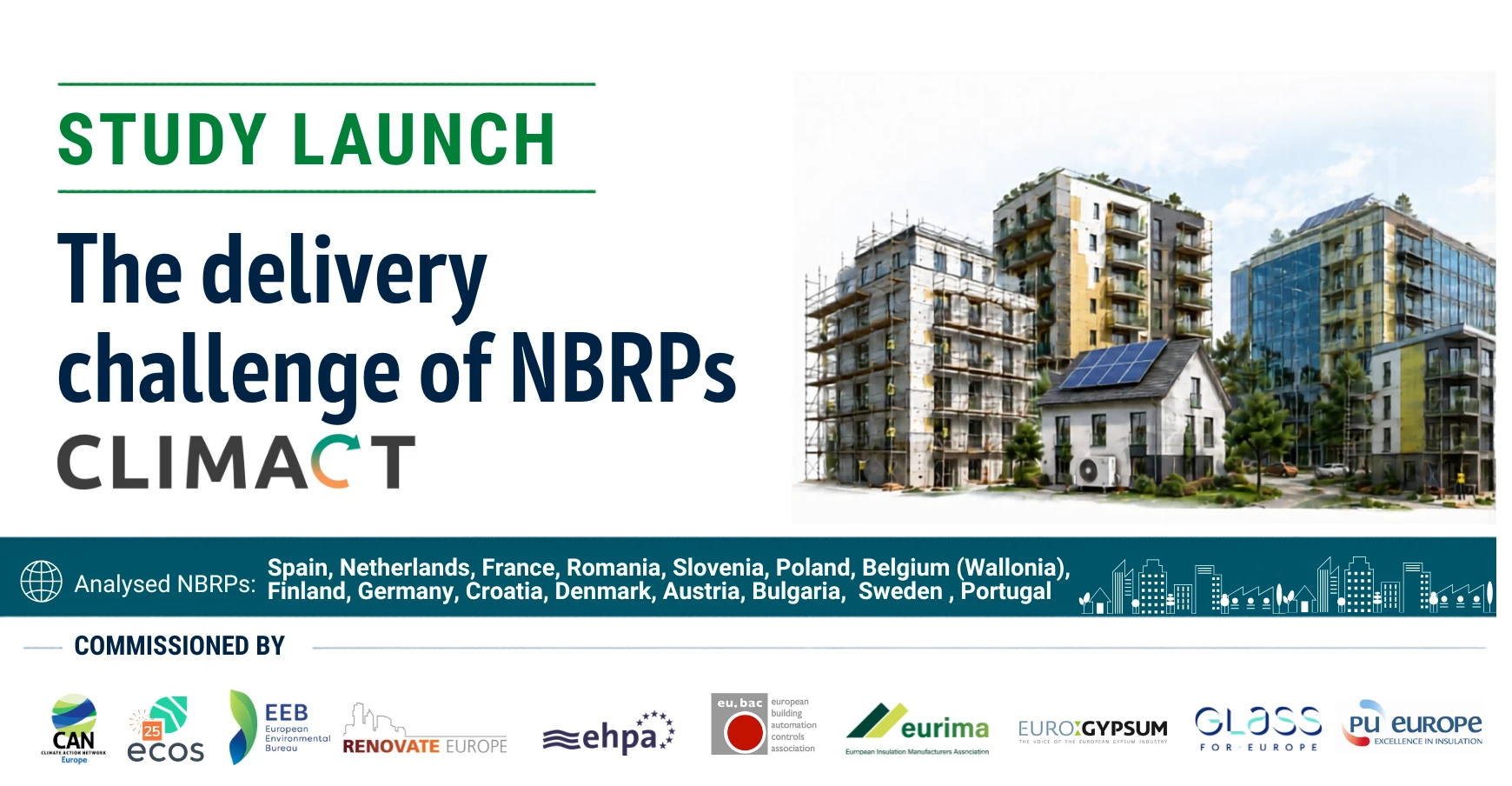
Renovate Europe, together with nine other organisations, is pleased to present the second and final part of “The delivery challenge of NBRPs”, developed by CLIMACT. Building on the first assessment published in May, this release expands the analysis to 15 draft plans: Spain, Netherlands, France, Romania, Slovenia, Poland, Belgium-Wallonia, Finland, Germany, Croatia, Denmark, Austria, Bulgaria, Sweden and Portugal.
Some key messages emerge from the assessment:
- Ambition is there, but delivery readiness is lagging: while all 15 plans set long-term decarbonisation objectives, none reaches the delivery-ready threshold. The challenge is no longer setting targets but translating them into actionable renovation pathways.
- The solutions already exist, but need to be connected and scaled: across the 15 plans, promising practices in financing, one-stop shops, regulatory frameworks and renovation delivery are emerging. Stronger coordination, peer learning and integrated delivery systems can turn these individual successes into effective national strategies.
- Major gaps remain in financing, implementation and social safeguards: plans often lack secured funding, clear regulatory timelines, adequate delivery capacity and robust monitoring frameworks. Social robustness is the weakest dimension, with insufficient attention to who bears the costs of renovation.
With the European Commission and Member States discussing the EPBD implementation on 21 October, and the deadline for submitting final NBRPs approaching at the end of 2026, this is a crucial moment to turn ambition into action.
Member States now have an opportunity to build on existing strengths, learn from one another and bring together the essential elements to deliver improved, coherent and actionable plans, capable of truly accelerating the transition towards a decarbonised building stock.
Read the full study and explore all the findings.
It comes in three documents: the executive report, a three-page assessment sheet for each country, and the cross-country analysis by theme.